
Review: Future Skinny
A gut and heart-wrenching buffet of suffering, depravity, love, and hope.

What up, horror homies?
Welcome to another horror recommendation/review from Clay’s Horror Corner. Today, we’ll be discussing Peter Rosch’s psychological, body-horror/neo-noir novel Future Skinny, about a man who can see the future by binge-eating. It’s exactly as traumatic and trippy as it sounds, and if you’ve ever had the pleasure of meeting Peter, you’ll know to expect nothing less.
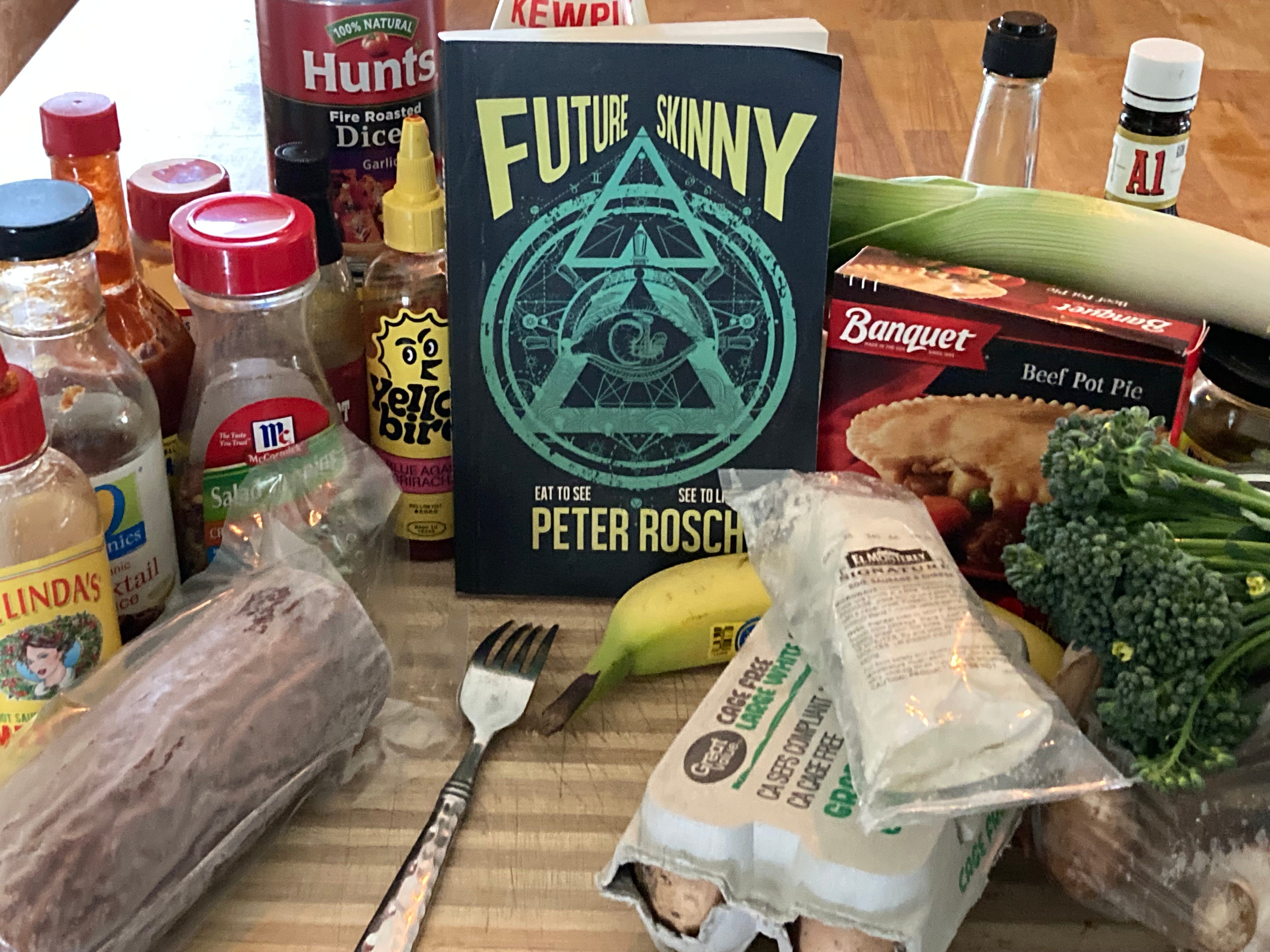
If you’ve read the book, this picture will make sense to you. If you haven’t, well, just imagine eating everything in the picture, including all those sauces, and you’ll have an approximation of what you’re in for while diving into this narrative. Peter does an excellent job of walking us through a truly harrowing exploration of eating disorders, familial trauma, exploitation of talent, and the lengths people will go to in order to protect the people they love. “Eat to see. See to live,” truly is a perfect tagline for this horrific novella.
That being said, every story has its upsides and downsides. No story is for absolutely everyone, and though I only review stuff that I WANT TO RECCOMMEND on this blog, I always like to let people know the things that did and did not work for me, so they can make an informed decision as to whether this story is something they want to delve into. Please just always remember that art is subjective, and all I can share is my own opinion and perspective.
So let’s rip off that bandaid and get into it.
What didn’t work for me:
The main issue I had with this story was the trope upon which it was built, and this trope comes under plenty of scrutiny without me chiming in, but there’s a reason for that. The trope being “it was all a dream.” Now, I am not actually in the camp of “this trope can NEVER work,” but it is a very difficult one to pull off as it’s been so overdone and so often done badly. While I don’t think Future Skinny is an example of it done in aggregious fashion, it doesn’t change the fact that it is leaning on a hot-button trope that’s sure to set some readers off and make it more difficult to enjoy the story. So, if you’re not interested in a story that takes place largely in the debatably-real future, this book may not be for you.
Like the trope above, I also knew going in that this would be a body-horror book (it’s about binge eating…so…), and I knew that wasn’t going to be my favorite aspect of it, by any means. I was correct. This took is disgusting, and as someone with a pretty rocky history around food, binging, unhealthy dieting/exercise balance (I was in wrestling for 20 years), there were certainly points of this book that were tough for me to get through. Not just because they were triggering, but because I genuinely DO NOT ENJOY spending time in those spaces. I hate the sound of eating. I don’t like people gorging themselves, and I don’t find it scary, simply gross. That is a big part of the reason body horror often doesn’t work for me. I like slow-burning, psychological horror with speculative elements, and the more the fear is derived from physical gore, the disgusting, or things like dismemberment, the less interested and engaged I become.
Finally, there’s another trope in here that tends to be a bit of a pet peeve of mine, and that’s the use of a therapist for the expositional character dumps. Nearly half of this story is a therapy session in which our MC vomits forth (pun intended) all of his interior motivations, and after a large portion of the book spent that way, it got a bit tiresome.
Okay…I hate that part. Sorry, Peter. You’re awesome, and so is this book. Let’s get to the good stuff:)
What Worked for Me:
Now, just to reiterate, I’m reviewing this book on Clay’s Horror Corner…that means I’m recommending it. That means I ultimately liked it enough that I truly want more people to read it, and I want it to get out into the world in greater volume, so take those above criticisms for what they are: cautions, critical analysis, things that subjectively weren’t my cup of the proverbial tea. The fact that I still liked this book, despite three pretty big hang-ups/turn-offs being extremely present in the work, is a testament to Peter’s prose, his character work, and his ability to subvert those tropes in a satisfying manner.
One of the biggest things that stood out to me in this book was Peter’s voice and his ability to infuse every scene with a sense of depravity, gloom, and hope all at the same time. This book is a brutal march through the labyrinthine depths of mental health struggles around anorexia and bulimia that, despite its grotesque nature, manages to build empathy and understanding for our protagonist, rather than pushing us further away from him, which can often happen. I think it’s a really good example of WHY and HOW people get stuck in these vicious mental cycles that keep them in toxic relationships with the very sustenance they need to survive.
To the same token, this book is a great analysis of toxic and damaging relationship structures, which is a prevalent theme across Peter’s bibliography. There’s a lot of psychological horror in this book that, rather than being detracted from by the more surface-level body-horror and disgust that the book presents, is actually amplified by those elements as we see Casey destroying himself in an attempt to provide for his family. Lylian (his partner) fights with all her might to pull him away from those habits, knowing the only thing he’s truly guaranteeing through his binge eating and future readings is his own destruction.
We do this, as humans. We make decisions that we think are best and ignore the insight of our most trusted loved ones until it is too late, and then the onous of providing ends up on their shoulders. Hopefully, we’re luckier than Casey and don’t also have gang-affiliated older siblings bent on revenge and extorting our gifts for their own profits while holding our loved ones for ransom…hopefully, we aren’t living in literal horror stories, as Casey is! Either way, Rosch has a way of showing us just how terrible that would be, were it the case.
Finally, this book has excellent character work. Though the therapist interview angle is something of a pet-peeve, I did enjoy most of it in this novella. Not only did Casey and Lylian feel real, empathetic, and natural, but the sessions with the therapist were clearly written from an informed and knowledgeable lens, and that realism goes a very long way when utilizing a trope that might have otherwise turned me off the story. The dialogue was compelling, the stakes high, and the mystery of the sessions (provided by redacted names, uncertain circumstances, and an unnamed, prevailing threat) kept the pacing at a breakneck speed, even as it changed from the crime-thriller vibes of Casey’s neo-noir POV to two people sitting in a room talking.
Overall, I rate this one 8/10. I highly recommend this book for anyone who loves the intersection of crime-thrillers and horror. It’s a great book for lovers of mental-health-centric, speculative fiction centered around tragic character dynamics, and I’m positive that you’ll enjoy it if you just give it a taste…
Speaking of a little taste, if you want to get to know Peter (or me) a little better, you can also check out our episode with him on Fermented Fiction. He joined us to debate The Menu, and we had a fantastic time. Hope you’ll give it a listen!
Until next time, this has been Clay’s Horror Corner. Go pick up your copy of Future Skinny RIGHT HERE and leave a review of your own if you love it, as there is no greater gift you can give to an author.
Thanks for tuning in, and we’ll see you next week. Happy Saturday!
-Clay